
Todoist Tips Straight From Todoist Power Users
Get Todoist tips from real users. Learn small habits, personal workflows, and simple setups that make work and life feel calmer and more manageable.

Todoist can be as simple or as powerful as you need it to be. With so many flexible features, no two people use it exactly alike. And part of the fun is finding the workflow that fits your work and life.
To show how people use Todoist in practice, we asked experienced users to share their best tips. Let these Todoist tips inspire the setup and habits that work for you.
Make Todoist your work and life system
Todoist is a tool for managing your work projects and your life tasks. That means there's no need to separate your personal and professional to-do lists into multiple apps.
"The biggest difference Todoist has made in my life is giving me one single place for everything," shares project manager Marie Roy.
"Before, my tasks, reminders, appointments, shopping lists, and side projects were scattered across apps, notes, and conversations. I was constantly wasting time trying to find things or keeping so much in my head just to check all the different apps."
Managing work and life in one tool helps Marie free up valuable mental space:
"Now, everything lives in Todoist, fully customized to fit exactly what I need, from shared shopping lists with my partner to focused work sessions. Using it as a life planner, brain dump, and accountability buddy means I can finally use my brainpower for something other than remembering what needs to be done."
Susan L. Holland, senior business analyst, takes a similar approach to using Todoist. She explains that one of the biggest perks is "having a place to put everything I think about that I need to do. And it's all organized, too. Now I only need to remember two things: 1. Put it in Todoist. 2. Look at Todoist."
Make Todoist work for you by creating projects for each area of life and work. Then, customize what displays on your dashboard.
Build the dashboard that works for you
Any task management tool can become overwhelming if its default view is an unfiltered inbox with all outstanding tasks. While you certainly can set Todoist up like this, there are much more manageable ways to use it.
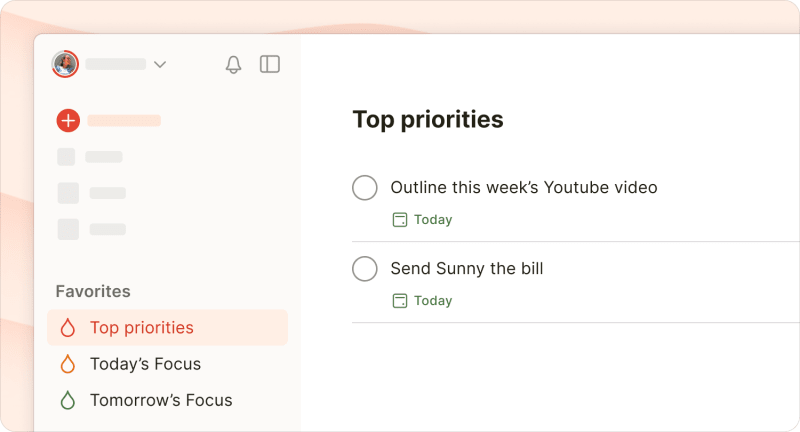
Carl Pullein, time management coach, uses favorites to easily find the filters that matter most for his daily workflow. As Carl explains:
"This allows me to create a simple workflow of my must-do tasks for the day, my should-dos, and finally my could-dos (if I have time). This one feature keeps me focused on the important and leaves the unimportant out of sight."
Find the Todoist filters you use most often and mark them as a "Favorite" to locate them easily. For example, you might favorite filters for tasks due that day or tasks related to important projects.
Using the Today view is another way to focus on your most time-sensitive work. This view automatically populates when you use Todoist's date or deadline feature. Andy Wardleworth, Director at Thunk, uses this approach to "get the important things done on time."
Break down goals with quarterly and weekly plans
To get clear on what you need to do during a given day or week, it's often helpful to zoom out and look at the bigger picture.
Chidinma Ofoegbu, fintech content marketer and LinkedIn account manager at Finnovio Studio, uses quarterly planning to stay organized. She shares this task management tip:
"I plan my year in quarters. Then, I break those quarterly goals into monthly goals. At the beginning of every week, I open Todoist and break those monthly goals down even further, fleshing them out into clear, doable daily tasks for the week."
To track and achieve goals with Todoist, set up a goal tracker project. Then, make big goals manageable by breaking them down into sections and tasks.
Match your workflow with projects, sub-projects, and folders
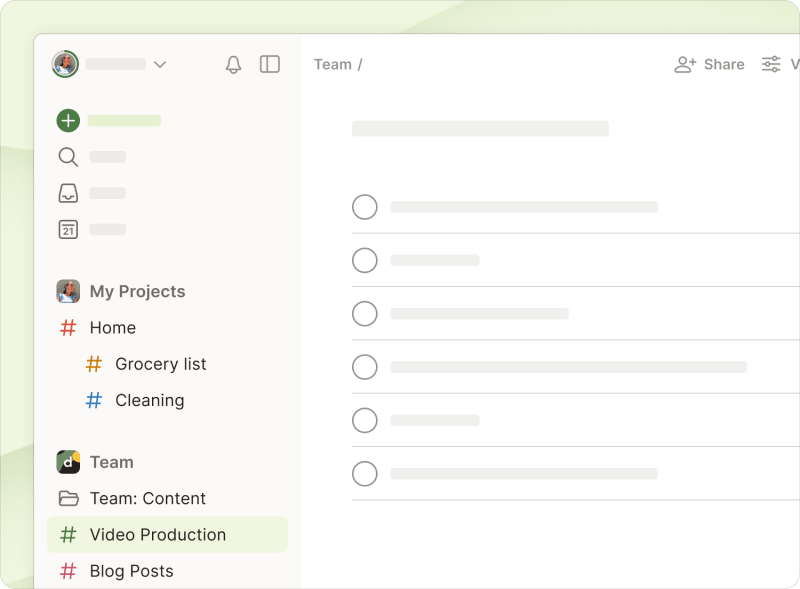
Projects are the key to staying organized in Todoist. Think of each project as a collection of related tasks. For instance, you might have projects for different goals you've set, jobs you're working on, or teams you're collaborating with.
You can create private projects on your Todoist dashboard or add them to your team dashboard to allow collaboration. If you need an extra layer for added organization:
Use folders for team projects
Use sub-projects for personal projects
As Eleanor Merson, Group Leader, NPL, puts it:
"Being able to have projects and sub-projects means that I can match the structure of my to-do lists to the structure of my notes, which makes it a lot easier to manage my life."
Organize big projects with sections
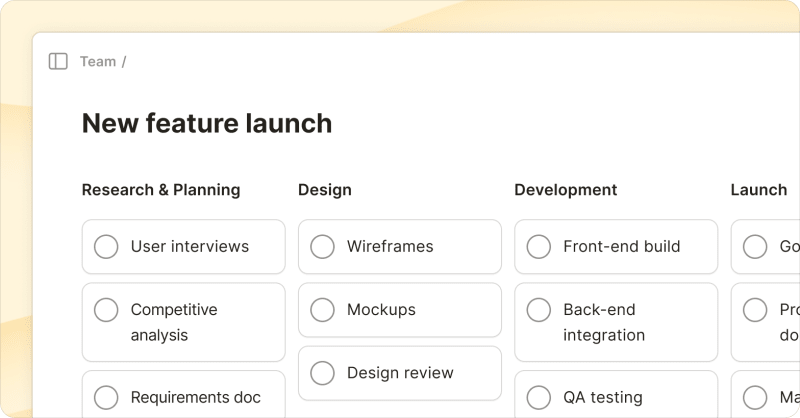
Sections break down projects into phases, themes, or milestones, preventing the project from morphing into an unwieldy task list.
"A recent goal of mine is to be more sustainable," shares freelance B2B marketer Nisha Shree. "So I have a project for that, and one section is a list of shops and stores with sustainable alternatives."
She explains: "Sometimes, when you start making changes, you're super excited and want to get everything. I add it to this project and come back to the list after a couple of weeks (add a reminder) to see if I really need it."
When you choose the board view for a project, sections and tasks display as a Kanban board. This gives you better visibility into project progress and helps you keep tasks organized.
Save time on repeat workflows with templates
Some projects are one-offs. But if you constantly repeat the same projects in your work or personal life, templates can save you a lot of setup time. Templates let you copy an existing setup to a new project so you don't have to configure it from scratch.
For example, you might restart a project every time you plan a trip, hire a new employee, or conduct a performance review.
As James Rigby, Director of Design Cloud, explains: "I made templates for design sprints and new client onboarding, so we don't have to reinvent the wheel."
In addition to reusing your existing projects, you can upload premade templates or borrow from Todoist's template gallery. There, you'll find templates for work and personal projects as well as full setups (projects, filters, and labels) based on popular productivity methods.
Keep focused with task labels
Projects are just one way to organize tasks. With labels, you can batch similar tasks together and pull them all up instantly. Labels are helpful for categorizing tasks based on the type of work involved.
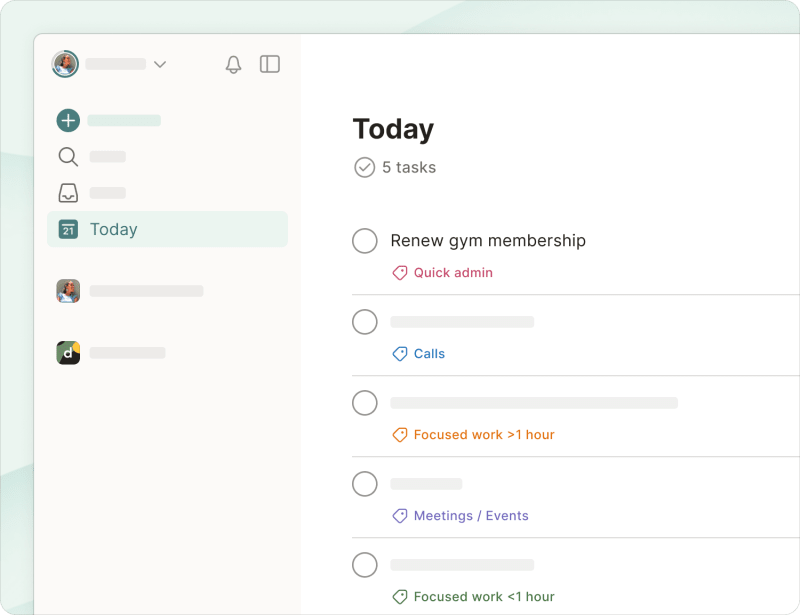
For example, Eleanor explains: "I label by meetings / events, quick admin, calls, focused work < 1 hour, and focused work > 1 hour. That way I can load up my day by the right amount."
Marie combines the Today view with labels to keep everything on track. She shares:
"Opening the Today tab gives me a clear snapshot of what I can tackle quickly, what deserves deep focus, and what can wait. Tags let me filter and see exactly what type of task I’m looking for, so I always know where to start and how to structure my day. This mix of an organized home screen and custom labels keeps me focused on the right things, every single day."
With Todoist, you can add as many labels as you need. You can also add color coding for an extra visual cue.
Schedule tasks quickly with Quick Add and keyboard shortcuts
Once you've decided how to structure Todoist for work and life, it's easy to start scheduling tasks.
Vojin Deronjic, operations consultant for tech companies, adds tasks to Todoist in the moment. This helps him clear mental space for higher-level thinking. Vojin explains:
"Instead of trying to remember everything, I trust Todoist to be my external memory. I capture every task, idea, and commitment as it comes up, which means I'm not constantly juggling mental reminders or worrying I'll forget something important."
Quick Add is the fastest way to get a new task on your to-do list. Just click "+ Add task" on your Todoist dashboard or press "Q" on your keyboard to open this tool.

Then, input task details like dates, durations, and labels. Use natural language to add dates and deadlines quickly.
For Francesco D'Alessio, Head of Content at Tool Finder, Quick Add and natural language input are essential. Francesco explains:
"It's a must way to capture things when they land in my brain, from links to ideas, or anything I need to get done. It's easy and simple and once you learn the basics, you're good to go."
Capture tasks and ideas on the go with Ramble
Don't have time (or a free hand) to type? Speak with Ramble instead.
Todoist's AI-powered voice assistant automatically transcribes what you say and pulls information like dates, priority levels, and projects. Then, it adds tasks, sub-tasks, and relevant details right where they belong on your to-do list.
Ramble works wherever you are. "It's so easy on the phone (one tap and speak, for example) and on my laptop, I use a keyboard shortcut," Carl shares. "This means that whether I'm driving, walking my little dog Louis, or at the supermarket, I can collect anything that comes to mind. It never lets me down."
To access Ramble even faster, create a shortcut on your smartphone. Shivani Shah, freelance content marketing and operations consultant, has a shortcut on her lock screen. Shivani explains:
"I literally just have to tap it, unlock my phone, and speak before I lose my train of thought. This comes in especially handy when I think of two or three things at one time (speaking is faster than typing) or when I suddenly remember something at 3 a.m., which happens more often than I'd like."
Jonathan Bravo, Director of Marketing & Communications for the Fresno Grizzlies, has Ramble mapped to the action button on his iPhone. He shares: "This has allowed me to add items to my Todoist from anywhere and the spur of the moment, since it seems like you also remember what things you need to do at the most inopportune moment!"
Turn emails into action with email integrations
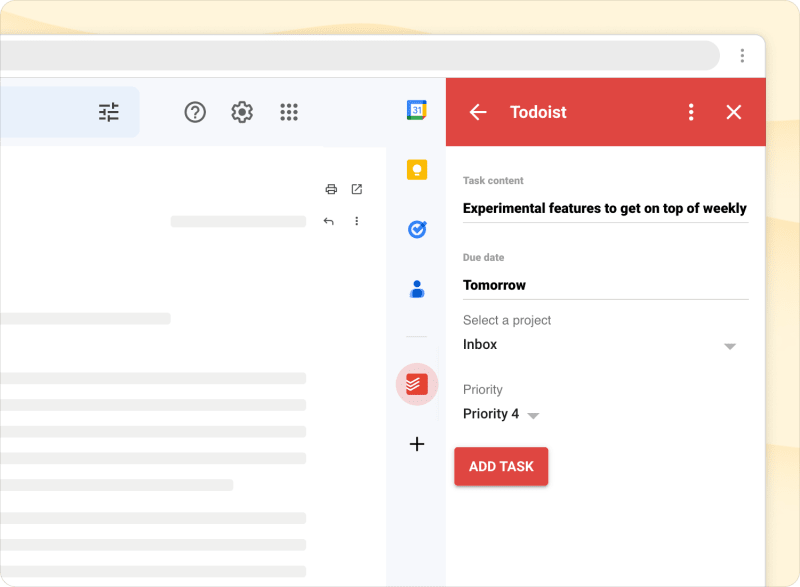
If a lot of your emails contain tasks, you have another option to build out your to-do list. Todoist's email integrations can help you get to inbox zero quickly without missing any important tasks.
Connect email apps like Gmail and Outlook with Todoist, and you'll be able to forward messages to your to-do list with just two clicks. You can add details like due dates, labels, and priority levels from your email interface.
As Keith Tessler, CEO of CMIT Solutions of Philadelphia, explains:
"Every email and phone call I get generates items in Todoist, which are then later prioritized to be done in the right order and put off to the dates when they will be accomplished. I manage literally hundreds of tasks in Todoist, but the thing is I never have to look at more than a few that need to be worked on at that moment."
Structure your day with time blocking
When you need more than a simple to-do list to organize your day, time blocking can help you plan and get things done. Like the name suggests, time blocking involves dividing your day into distinct blocks of time. During each block, you might focus on a specific project or a certain type of task.
Think of it as a way to schedule your day so you never have to think about what to work on next.
With Todoist's calendar layout, it's easy to set up time blocking. Add dates and durations to tasks, and they'll automatically appear as blocks on the calendar layout. Or drag and drop all-day tasks to specific blocks on the calendar.

Time blocking is a key part of Francesco's Todoist setup. He explains:
"Todoist gives me the clarity to focus on the right things. It allows me to capture things that I need to process, the time blocking to implement the work, and then the ability to feel accomplished in my day to better focus on them. I've been using Todoist for over 10 years now and it's just a golden bullet to my busy day."
Stay on top of cyclical work with recurring dates
Some tasks come up repeatedly: every day, week, month, or quarter. When this happens, you don't have to manually add each occurrence to your to-do list. Instead, use Todoist's recurring dates.
Shivani uses this feature to avoid missing recurring payments (credit card and phone bills), filing taxes, and annual health insurance renewals. She shares:
"I never have to worry about missing a payment or trying to remember it in the first place. I set the task due date for a week before the actual deadline. This means if life or work gets busy, I still have a few days’ buffer to get it done. (And I’ll see the overdue task when I open Todoist every morning so I can’t forget it.)"
When you add a task in Todoist, use natural language to clarify how often you need to repeat the task. For example: "every Monday at 10am." It'll automatically appear on your to-do list every week.

As Susan puts it: "If there's something I need to check on or do every day or every third month, I can just put it in, set it to repeat, and free up my brain for other work."
Plan your day with priority levels
Not all tasks are created equal. Some might be essential to complete on a certain day, while others might have more flexible deadlines.
Priority levels help you keep track of which life and work tasks are most and least important. For Michaela Jarvis, Customer Success Manager at Launchbay, priority levels are key to structuring the workday. She shares:
"I get a lot of ad-hoc requests via emails or during calls. I don't usually have the capacity to drop whatever I'm doing and immediately handle those requests. Being able to quickly create a new task, mark its priority and add some extra details has been a game changer. It keeps me organized, efficient, and reliable."
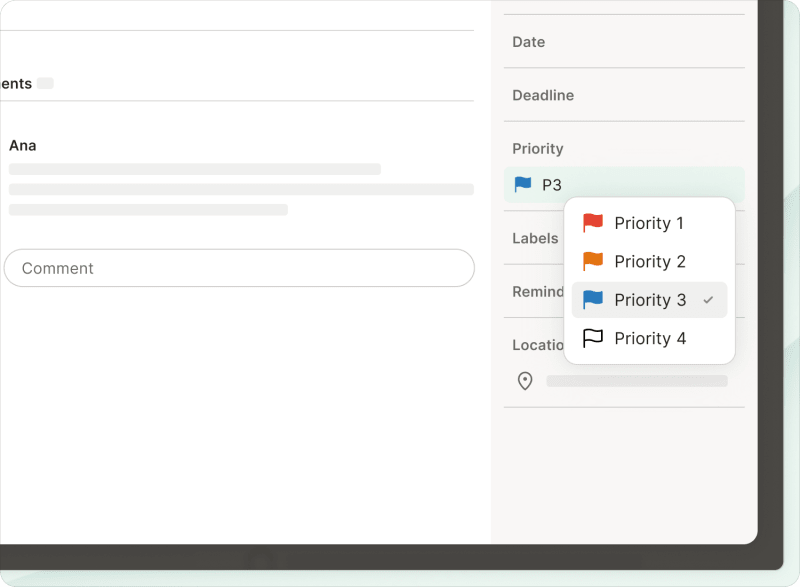
Todoist has four color-coded priority levels:
Priority 1 (red): Urgent tasks
Priority 2 (orange): Important tasks
Priority 3 (blue): Less important tasks
Priority 4 (gray): Non-urgent tasks
To apply priority levels, select them manually in the task interface or use natural language in the description. For example: "Client task, p1."
Never miss what matters with reminders
When you have mission-critical tasks to do, simply seeing them on your to-do list or calendar layout might not be enough to prompt you to complete them. This is where reminders come in handy.
With Todoist, you have a few different options for reminders. You can opt to get desktop, mobile, or email reminders, so you choose the option that works best for your workflow.
"Reminders are the backbone of my entire productivity system," Vojin explains. "They're what actually helps me get things done. I've built a pretty solid system around them, often setting multiple reminders for super important tasks to make sure nothing slips through the cracks."
See everything in one place with calendar integrations
Managing events, meetings, and appointments with family, friends, or teams often takes place in calendar apps like Google Calendar or Outlook Calendar.
There's no need to manually enter those events in Todoist. Instead, you can sync them via a native calendar integration.
Just connect your calendar of choice, and your calendar events will automatically appear in your Today view, Upcoming view, or calendar layout.
Marie notes that syncing her Google Calendar with Todoist helps her adjust her schedule much faster. "Moving a task to a new day takes two clicks, not five minutes of juggling calendars. That central, flexible workflow keeps me organized, productive, and fully in control of both work and life."
Keep teams aligned with task assignments and timelines
Todoist can be incredibly helpful for managing work and life tasks independently. But it's even better with a team.
When you onboard your team, you can assign tasks to specific team members. This way, everyone knows what they're responsible for, decreasing the chance of anything falling through the cracks.
Jonathan's team relies on Todoist for task management, including task assignments and timelines. He explains:
"Our entire team has access not only to our designated Marketing Team board, but we also have separate projects inside our Todoist business for areas we need extra emphasis in. Using Todoist in our daily workflow has made us more efficient and has allowed me to assign tasks to my staff with valuable context and due dates we can track toward."
Andy's team also depends on Todoist for delegation. He shares:
"We've tried a number of tools to help us distribute tasks, whether for projects or day-to-day work, and Todoist has been the one that stuck. That's because of the flexibility of the platform for delegating, managing timelines, and priorities. It's so much more than a to-do list."
There's no single right way to use Todoist, and these productivity tips are proof.
Choose an idea that resonated with you, and adapt it to your Todoist workflow. Small changes to how you organize your work and life can add up to a real difference over time.

Anna Sonnenberg
Anna Sonnenberg is a writer, editor, and strategist with over a decade of experience creating content for B2B SaaS companies like Agorapulse, Komodo, and Relato. As a seasoned freelancer managing a dynamic client roster, she's always testing productivity and time management tactics.